Call Recording vs Full Conversation Intelligence: The Gap
Call recording stores audio files. Conversation intelligence adds transcription, search, CRM sync, and AI analytics. Here's exactly where each approach wins.
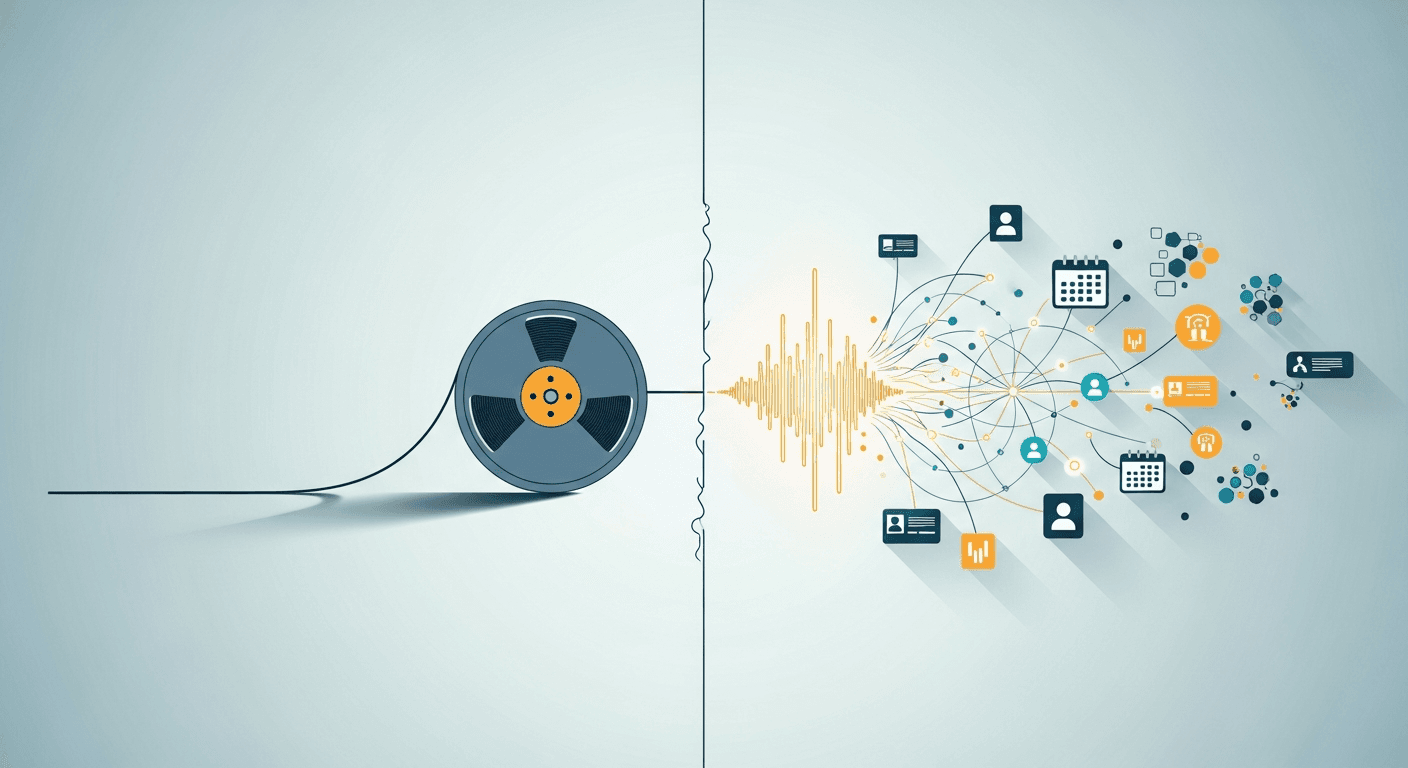
TL;DR: When comparing call recording vs conversation intelligence, the difference comes down to searchability, compliance depth, and CRM automation. Basic recording suits simple, single-channel needs; conversation intelligence platforms are built for teams that need accountability at scale.
Most teams already know they need a record of every customer conversation. What separates call recording vs conversation intelligence is how much structure you need wrapped around that record. On one end sits basic call recording — an audio file saved to a server. On the other sits full conversation intelligence — transcription, sentiment analysis, keyword search, CRM linkage, and per-contact timelines built automatically from every channel. Both solve a real problem. Neither is universally right. This article breaks down exactly where each approach wins, where it falls short, and how to decide which one your organization actually needs.
Call Recording vs Conversation Intelligence: Key Differences
| Dimension | Basic Call Recording | Full Conversation Intelligence |
|---|---|---|
| Setup complexity | Low — often a single toggle in your phone system | Moderate — requires integrations, CRM mapping, and channel configuration |
| Searchability | By date, caller ID, or agent — not by spoken content | Full-text search across transcripts, keywords, and topics |
| Compliance coverage | Proves a call occurred; limited content verification | Proves content, tone, script adherence, and disclosures |
| CRM linkage | Manual or metadata-only | Automatic per-contact timeline across calls, SMS, voicemail, email |
| Typical monthly cost (SMB) | $0–$25 as an add-on to existing phone plans | $50–$300+ depending on seats, channels, and AI feature depth |
| Best fit | Low-dispute, single-channel operations needing a basic audit trail | Multi-channel, compliance-heavy, or coaching-focused organizations |
What Basic Call Recording Actually Gives You
Basic call recording captures audio from inbound and outbound calls and stores it as an MP3 or WAV file tagged with a timestamp, caller ID, and sometimes an agent name. Most modern VoIP platforms include this natively. RingCentral's call recording overview illustrates how straightforward configuration typically is. For small business purposes, simplicity is a genuine advantage — enabling recording is usually a settings toggle and a compliance disclosure update.
Where it works well:
- Near-zero deployment friction. No dedicated IT resources needed.
- Cost-effective for light use. Many SMB phone plans bundle basic recording at no additional charge.
- Legally defensible audio artifact. In a dispute, the voice recording carries evidentiary weight, especially in industries governed by Regulation Z or similar requirements.
- Low storage overhead. Compressed audio files are small compared to structured data stacks.
Where it breaks down:
- Not searchable by content. If a customer disputes what was said about a specific fee three months ago, someone must manually scrub audio — a process that does not scale and can cost more in staff time than a year's subscription to a conversation intelligence platform.
- No channel coverage beyond calls. SMS, voicemail, and email are entirely outside the recording system, a critical gap when comparing call recording vs transcription or full conversation intelligence.
- No automatic CRM integration. Audio files are stored in isolation unless your team manually attaches them to contact records — a step that rarely happens consistently.
- Zero coaching or QA leverage. Without transcripts or scoring, managers must listen to calls in real time or scrub audio — both expensive uses of management time.
When Basic Recording Is the Right Call
Retail appointment logging: A small boutique scheduling consultations by phone needs only a timestamped audio record in case a client disputes an appointment time or cancellation policy. The owner can pull the file by date, hit play, and resolve the issue in under a minute.
Sole-proprietor service business: A plumber handling inbound calls wants a backup of scope-of-work agreements discussed verbally before a job starts. With call volume under thirty calls per week and no SMS or email channel carrying legal weight, basic recording is proportionate to the need.
Entry-level call recording is available through virtually every major VoIP provider. Platforms like Vonage and 8x8 offer it as a bundled or low-cost add-on. Basic call recording fits organizations with a single communication channel, low dispute frequency, and no regulatory requirement to demonstrate specific disclosures or script adherence.
What Full Conversation Intelligence Actually Gives You
Full conversation intelligence software transcribes every call in near real time, applies natural language processing to identify topics, sentiment, keywords, and action items, then links all of that structured data to the correct contact record and timeline. The best systems extend this to voicemail, SMS, and email — creating a unified, searchable history of every touchpoint. AI conversation analytics makes it possible to search six months of calls by keyword in seconds rather than hours.
Platforms like Gong pioneered this category in sales contexts; purpose-built tools have since emerged for operations, compliance, and front-office teams across property management, healthcare administration, and education. QuorumVoice sits in this category, built specifically for HOAs, property managers, schools, small businesses, and nonprofits that need every call, voicemail, SMS, and email captured, transcribed, categorized, and attached to a per-contact timeline — with CRM integration included. The emphasis is on operational accountability rather than sales coaching, a meaningful distinction in any conversation intelligence software comparison.
Where it works well:
- Full-text search across all conversations. Finding every interaction where a specific fee, policy, or instruction was discussed takes seconds. This single capability defines the gap between AI conversation analytics and passive storage.
- Automatic per-contact timelines. Every call, voicemail, SMS, and email rolls up to the contact record automatically. See also: how to track every call, email, and text without a paper trail.
- Compliance-grade content verification. Transcripts prove what was said, when disclosures were made, and whether scripts were followed — critical where call recording compliance requirements extend to content, not just the existence of a record.
- Coaching and QA at scale. Managers can review flagged calls, search for objection types, or track issue frequency without listening to hours of audio.
- Multi-channel coverage. SMS threads and voicemails carry the same legal and operational weight as phone calls; having them in one searchable system eliminates dangerous blind spots.
Where it breaks down:
- Integration work upfront. Mapping CRM fields, configuring channel ingestion, and training staff takes days to weeks — the most common friction point in any conversation intelligence software comparison.
- Higher cost. AI transcription, NLP processing, and storage infrastructure means pricing is materially higher than basic recording.
- Transcript accuracy is not perfect. Accented speech, technical jargon, or poor audio quality can introduce errors requiring human review before high-stakes legal use.
- Potential overload for very small teams. If two staff members handle thirty calls a week, the analytics dashboard may surface more insight than the team has bandwidth to act on.
When Conversation Intelligence Is the Right Call
Property manager dispute resolution: When a resident disputes a fee increase and claims they were never notified, a conversation intelligence platform lets the manager search by contact name and keyword in seconds. The exact call, transcript, and timestamp surface immediately — no audio scrubbing, no he-said-she-said. For tools built for this context, see top call logging tools for property management companies.
HOA board accountability: An HOA with part-time staff and high board turnover faces persistent institutional memory loss. When a new board member asks why a policy was communicated a certain way eight months ago, conversation intelligence surfaces the full interaction history in seconds rather than an afternoon of searching email threads and voicemail inboxes.
Sales coaching and TCPA compliance: A regional insurance brokerage using outbound sales call recording must verify agents delivered mandatory disclosures and obtained proper consent before texting. AI conversation analytics flags calls where disclosure language was absent and generates a weekly exception report — replacing a manual QA process that previously consumed twelve hours per week of supervisor time.
Sales-focused platforms like Gong and Chorus.ai (now part of ZoomInfo) typically price at $100–$200 per seat per month. Operations-focused tools often price by conversation volume or a flat organizational rate. Budget $50–$150 per month for an entry-level conversation intelligence platform with CRM integration. The Rev transcription benchmark gives useful context on accuracy standards to hold any platform to.
Head-to-Head: Call Recording vs Conversation Intelligence by Use Case
Compliance Audits and Dispute Resolution — Conversation Intelligence Wins
When a homeowner disputes that they were notified about a fine, the relevant question is not whether a call happened — it is what was said. Basic call recording can prove the former; only a transcript-backed system can efficiently prove the latter. SHRM's documentation best practices guidance reinforces this: the quality of your documentation, not just its existence, determines its protective value. For more on how recording compliance requirements vary by jurisdiction, see the state of recording compliance across city and county offices.
Sales and Coaching Teams — Conversation Intelligence Wins
No serious coaching or QA program scales on audio files alone. Identifying coachable moments, tracking objection frequency, or verifying disclosure language requires searchable transcripts and topic tagging. Salesforce's conversation intelligence resource outlines why transcript-driven coaching has become the baseline expectation for modern sales and service teams.
Small Business with Minimal Call Volume — Basic Recording Wins (with caveats)
A sole proprietor handling ten to twenty calls per week, operating in a single channel, and facing minimal compliance pressure may genuinely be over-served by full conversation intelligence. The caveat: if SMS or voicemail exchanges carry contractual weight, the channel blind spot of basic recording becomes a liability sooner than expected.
Multi-Channel Front Office (Schools, Nonprofits, HOAs) — Conversation Intelligence Wins
Organizations fielding communication across calls, voicemail, and SMS — often handled by part-time or volunteer staff with high turnover — face real and recurring risk of losing institutional memory or missing a documented complaint. Conversation intelligence platforms designed for this use case address the channel coverage, per-contact timeline, and CRM integration requirements that basic recording cannot.
Regulated Industries Requiring Disclosure Verification — Conversation Intelligence Wins
Financial services, healthcare administration, and property management in many jurisdictions require demonstrable proof that specific disclosures were made. The FDIC compliance manual's recordkeeping guidance and similar frameworks make clear that the standard is proof of content, not just proof of contact. Transcript search and keyword flagging are the operational mechanism by which call recording compliance is demonstrated at audit time.
How to Choose: Four Questions That Settle the Decision
- How many channels carry legally or operationally significant conversations? If more than one — calls plus SMS, or calls plus voicemail — basic recording leaves you exposed. The call recording vs transcription debate becomes secondary once you realize SMS and voicemail carry equal legal weight in most disputes.
- What is the realistic cost of a single unresolved dispute or compliance failure? If it is measured in thousands of dollars or reputational damage, the cost differential between basic recording and a conversation intelligence platform collapses quickly. A single avoided legal escalation typically exceeds a full year of AI conversation analytics subscription costs.
- Do you have staff time to review audio manually when an issue arises? If not, you need searchable transcripts. Paying someone to scrub recordings costs more per incident than the annual price difference between the two approaches.
- Is coaching, QA, or performance accountability part of your management model? If yes, full conversation intelligence software is the infrastructure that makes systematic improvement possible.
The right system is not the one with the most features — it is the one whose features map directly to the failure modes your organization cannot afford.
Frequently Asked Questions
No. Call recording captures and stores audio only. Conversation intelligence adds AI call transcription, sentiment analysis, keyword search, and CRM linkage on top of that audio. The difference is between a filing cabinet full of tapes and a fully indexed, searchable database — both contain the same raw information, but only one lets you retrieve specific content in seconds.
It depends on what your compliance framework requires. If regulators require only proof that a call occurred, basic call recording may be sufficient. If you must demonstrate that specific disclosures were made or particular language was used, call recording compliance at that level requires transcripts and searchable content. Financial services, healthcare administration, and property management in many states fall into the latter category.
Yes. Conversation intelligence platforms include call recording as a baseline and build on top of it. You do not run both systems in parallel — conversation intelligence software subsumes basic recording and adds structured data, transcription, and analytics. The audio artifact still exists and is still accessible.
Call recording vs transcription is a distinction of format: recording produces an audio file; transcription converts that audio into searchable text. Transcription alone is a meaningful upgrade over raw recording, but it stops short of full conversation intelligence, which adds topic detection, sentiment scoring, CRM linkage, and multi-channel coverage.
Call recording for small business is the right starting point if you operate on a single channel with low dispute frequency and no regulatory disclosure requirements. However, many small businesses underestimate how quickly the calculus shifts. The moment you add SMS as a communication channel or face your first unresolvable dispute, basic recording becomes insufficient. Entry-level conversation intelligence platforms now start at $50–$150 per month, making the upgrade accessible well before enterprise scale.
If you manage a small, single-channel operation with low dispute frequency and minimal compliance requirements, basic call recording is sufficient and worth keeping simple. Enable it in your existing phone system and invest your energy elsewhere.
If you manage a multi-channel front office, operate in a compliance-sensitive industry, or need staff accountable for what they communicate — not just whether they communicated — full conversation intelligence is the appropriate infrastructure. The ability to search every conversation, link it to a contact, and retrieve the exact content of an exchange from six months ago is not a premium feature; it is the baseline for professional operations at any meaningful scale. When doing a proper conversation intelligence software comparison, searchability and CRM linkage are the single most important dimensions to evaluate. For organizations in HOA management, property management, schools, and nonprofits, QuorumVoice was built for exactly this operational profile. Whatever path you choose, the decision framework is the same: match the capability to the failure mode, not to the feature list.
Written by

Derrick Threatt is an AI Automation Engineer and marketing operations leader who builds AI-driven systems, automations, and data workflows to improve revenue, operations, and team productivity.
View all posts →Latest from the blog. Keep reading.
View all →
Best Phone Systems for Small Business in 2025: Honest Picks for Teams That Can't Afford to Miss a Call
HOA and property management offices need more than sales-team phone tools. See how Allo, OpenPhone, Dialpad, Nextiva, and QuorumVoice handle resident calls.

40 HOA & Property Management Text Message Templates (Copy-Paste Ready)
40 copy-paste HOA and property management text templates for missed calls, maintenance updates, dues reminders, and after-hours compliance.

SMS Opt-In Examples & Compliant Templates for HOAs and Property Managers
Copy-paste SMS opt-in examples and compliant templates built for HOAs and property managers, covering 10DLC rules, confirmation texts, and consent tracking.