HOA violation notice text templates for common issues like parking, trash, and landscaping
Ready-to-copy HOA violation notice text templates for parking, trash, and landscaping—covering 1st, 2nd, and final notices with workflow tips.
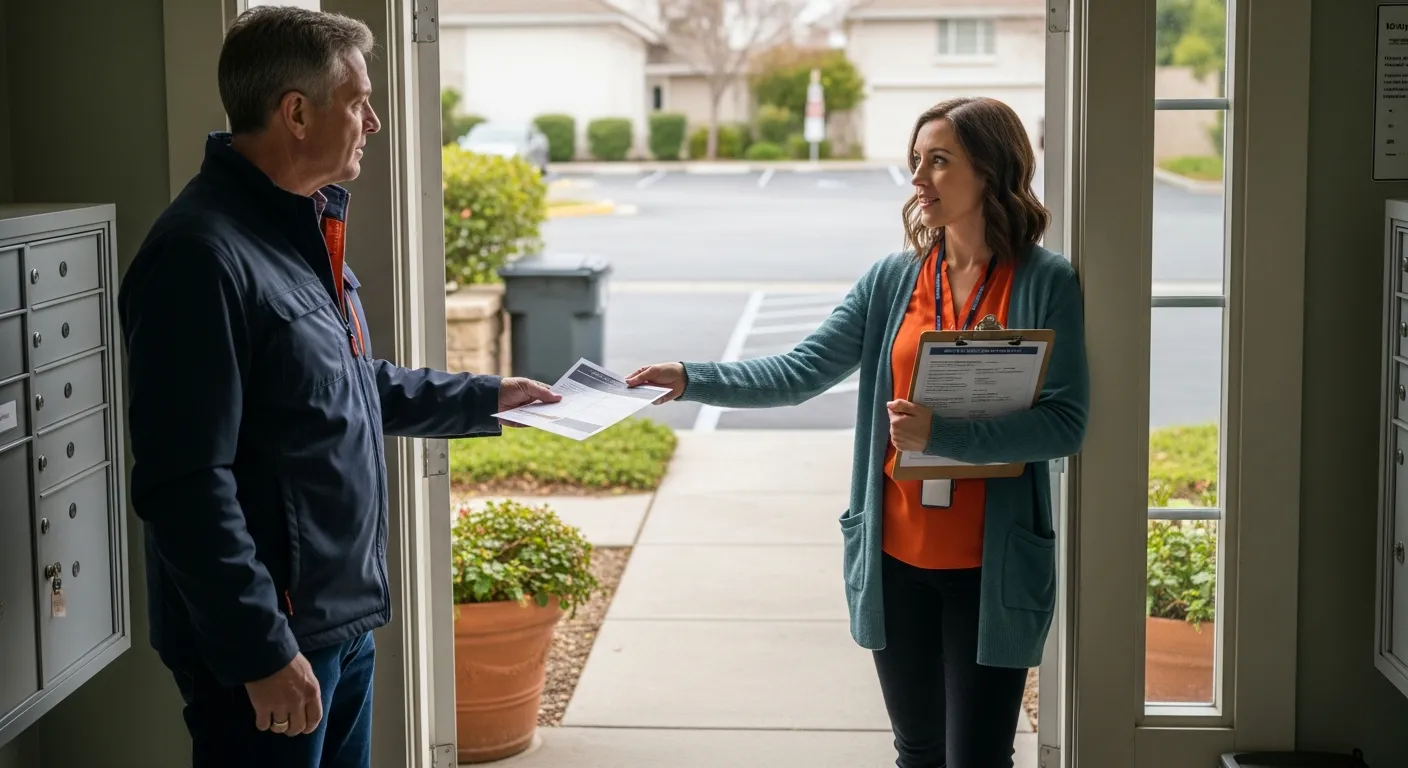
HOA violation notice text templates give boards and property managers a consistent, defensible way to handle the most common compliance issues — parking, trash, and landscaping. This guide leads with ready-to-copy templates for each violation type, structured as 1st, 2nd, and final notices, then covers the workflow, metrics, and legal considerations that make those notices hold up. Disclosure: QuorumVoice is the publisher of this article. Where QuorumVoice features are mentioned, they represent first-party product recommendations.
Jump to: Parking Templates | Trash Templates | Landscaping Templates | SMS Templates | Workflow | FAQ
HOA Parking Violation Notice Templates
1st Notice — Parking
Subject: HOA Violation Notice – Parking – [Property Address] – Action Required by [Deadline Date]
[Date]
Dear [Homeowner Name],
This notice is to inform you that [Vehicle Make, Model, Color, License Plate] was observed in violation of Section [Rule Section Number] of the community governing documents at [Location] on [Date/Time].
Please correct this violation by [Deadline Date]. Failure to do so may result in fines per the association's fine schedule, beginning at $[Amount].
You have the right to request a hearing before the board within [X] days of this notice by contacting [HOA Contact Name] at [Phone/Email].
Sincerely,
[HOA Manager Name]
[Association Name]
Copy this template and replace all bracketed fields with your community's specifics. Align the rule section number and cure deadline with your CC&Rs and bylaws before sending.
2nd Notice — Parking
Subject: Second HOA Violation Notice – Parking – [Property Address] – Immediate Action Required
[Date]
Dear [Homeowner Name],
This letter follows our previous notice dated [Prior Notice Date]. The parking violation described below has not been corrected.
[Vehicle Make, Model, Color, License Plate] remains in violation of Section [Rule Section Number] at [Location].
Please correct this violation by [Deadline Date]. A fine of $[Amount] has been or will be assessed per the association's fine schedule. You retain the right to request a hearing before the board within [X] days by contacting [HOA Contact Name] at [Phone/Email].
Sincerely,
[HOA Manager Name]
[Association Name]
Final Notice — Parking
Subject: Final HOA Violation Notice – Parking – [Property Address] – Hearing Scheduled
[Date]
Dear [Homeowner Name],
This is a final notice regarding the unresolved parking violation at [Property Address] (prior notices dated [Date 1], [Date 2]). The violation of Section [Rule Section Number] has not been cured.
A hearing has been scheduled for [Hearing Date/Time] at [Location]. You may appear to present your case. If the violation is not corrected before that date, the board may impose fines per the fine schedule and pursue additional remedies allowed under the governing documents and [State] law.
Contact [HOA Contact Name] at [Phone/Email] with questions.
Sincerely,
[HOA Manager Name]
[Association Name]
HOA Trash & Debris Violation Notice Templates
1st Notice — Trash
Subject: HOA Violation Notice – Trash/Debris – [Property Address] – Action Required by [Deadline Date]
[Date]
Dear [Homeowner Name],
Trash containers and/or debris were observed in violation of Section [Rule Section Number] of the community governing documents at [Property Address] on [Date/Time]. The specific condition observed: [describe — e.g., bins left at curb 48 hours after pickup, loose debris in driveway].
Please correct this condition by [Deadline Date]. Continued non-compliance may result in fines beginning at $[Amount] per the association's fine schedule.
You have the right to request a hearing within [X] days by contacting [HOA Contact Name] at [Phone/Email].
Sincerely,
[HOA Manager Name]
[Association Name]
2nd Notice — Trash
Subject: Second HOA Violation Notice – Trash/Debris – [Property Address]
[Date]
Dear [Homeowner Name],
This follows our prior notice dated [Prior Notice Date]. The trash or debris violation at [Property Address] referenced in Section [Rule Section Number] has not been corrected.
Please remove or correct the condition by [Deadline Date]. A fine of $[Amount] has been or will be assessed. Your right to a board hearing remains available — contact [HOA Contact Name] at [Phone/Email] within [X] days of this notice.
Sincerely,
[HOA Manager Name]
[Association Name]
Final Notice — Trash
Subject: Final HOA Violation Notice – Trash/Debris – [Property Address] – Hearing Scheduled
[Date]
Dear [Homeowner Name],
This is a final notice for the unresolved trash/debris violation at [Property Address] (prior notices: [Date 1], [Date 2]). The violation of Section [Rule Section Number] continues as of [Inspection Date].
A hearing is scheduled for [Hearing Date/Time] at [Location]. Fines will continue to accrue per the fine schedule until the condition is corrected. Additional remedies available under the governing documents and [State] statute may also be pursued.
Contact [HOA Contact Name] at [Phone/Email] with questions.
Sincerely,
[HOA Manager Name]
[Association Name]
HOA Landscaping Violation Notice Templates
1st Notice — Landscaping
Subject: HOA Violation Notice – Landscaping – [Property Address] – Action Required by [Deadline Date]
[Date]
Dear [Homeowner Name],
The landscaping at [Property Address] appears out of compliance with Section [Rule Section Number] of the community governing documents as of [Inspection Date]. Observed condition: [describe — e.g., grass exceeds [X] inches, dead vegetation present, unapproved plant material installed].
Please complete required maintenance or submit an architectural change request by [Deadline Date]. Fines begin at $[Amount] per the association's fine schedule if the condition is not corrected.
You have the right to request a hearing before the board within [X] days by contacting [HOA Contact Name] at [Phone/Email].
Sincerely,
[HOA Manager Name]
[Association Name]
2nd Notice — Landscaping
Subject: Second HOA Violation Notice – Landscaping – [Property Address]
[Date]
Dear [Homeowner Name],
This follows our prior notice dated [Prior Notice Date]. The landscaping condition at [Property Address] in violation of Section [Rule Section Number] has not been corrected.
Please complete the required maintenance by [Deadline Date]. A fine of $[Amount] has been or will be assessed per the fine schedule. Your right to a board hearing remains — contact [HOA Contact Name] at [Phone/Email] within [X] days.
Sincerely,
[HOA Manager Name]
[Association Name]
Final Notice — Landscaping
Subject: Final HOA Violation Notice – Landscaping – [Property Address] – Hearing Scheduled
[Date]
Dear [Homeowner Name],
This is a final notice for the unresolved landscaping violation at [Property Address] (prior notices: [Date 1], [Date 2]). The condition violating Section [Rule Section Number] remains uncorrected as of [Inspection Date].
A hearing is scheduled for [Hearing Date/Time] at [Location]. The board may impose additional fines and pursue remedies permitted under the governing documents and [State] law. If the condition is corrected before the hearing date, notify [HOA Contact Name] at [Phone/Email] immediately.
Sincerely,
[HOA Manager Name]
[Association Name]
HOA Violation Notice Text Message Templates (SMS)
Most states allow informal notice by text or email, but formal enforcement steps — fines, hearings — typically require written notice by mail or certified mail under your governing documents. Use these SMS templates for initial outreach and follow-up coordination, not as a substitute for the formal letter. Always confirm you have proper TCPA consent before texting owners; see the TCPA compliance guide for property managers for guidance on opt-in requirements and record-keeping.
- Parking (SMS): "HOA Notice: A parking violation was observed at [Address] on [Date]. Please correct by [Deadline] or call [Phone]. Full details sent to your email. Reply STOP to opt out."
- Trash (SMS): "HOA Notice: A trash/debris concern was noted at [Address] on [Date]. Correction needed by [Deadline]. Questions? Call [Phone]. Full notice sent by email/mail. Reply STOP to opt out."
- Landscaping (SMS): "HOA Notice: Landscaping at [Address] appears out of compliance as of [Date]. Please correct by [Deadline] or contact [Phone]. Formal notice sent separately. Reply STOP to opt out."
Keep SMS messages under 160 characters where possible. Always include an opt-out instruction and log every outbound message. For teams handling high volumes of owner texts alongside calls and voicemail, a shared inbox for email and text keeps every channel tied to the same owner record and reduces duplicate follow-up.
How to Run the HOA Violation Notice Workflow
Verify the violation before you write
Before sending any HOA compliance notice, confirm three things: what was observed (vehicle description, bin placement, lawn condition), which rule section applies, and what cure window the governing documents allow. Photograph the condition, note the date and time, and record the address and rule section in your case file.
Many state HOA statutes — including Florida's §720.305 and California's Civil Code §5850 — specify minimum notice periods and delivery methods. Check your state's requirements before setting a deadline. The Community Associations Institute (CAI) publishes state-specific legislative guides that are a useful reference for boards and managers.
Select the right notice stage and fill in the template
Use the 1st notice for a first observed violation. Issue the 2nd notice if the cure deadline passes without correction, referencing the prior notice date. Move to the final notice — which triggers hearing rights — only after two prior written notices, unless your documents allow faster escalation. Keeping one template per violation category ensures neutral HOA violation letter language stays consistent across staff members.
Send through the right channel and keep proof
Deliver formal notices by the method required in your governing documents — often first-class mail, and certified mail for fines or hearings. Use email and SMS for initial outreach and reminders. Log the channel, date sent, and any delivery confirmation. QuorumVoice (our platform) attaches inbound and outbound calls, texts, and emails to the same owner record, making it straightforward to show a complete notice history if a dispute reaches the board. For more on tracking multi-channel owner communication without a paper trail, see our call and message logging guide.
Track the response and close the loop
Every notice needs a designated follow-up owner and a next action date. If the owner cures the violation, record the cure date and close the case. If they dispute, route the matter to the hearing process. If they request more time, document the request and any deadline extension. Assign one staff member per case to prevent conflicting communications reaching the same owner.
What to Measure — and What Good Looks Like
| Metric | Why it matters | Target range |
|---|---|---|
| Time from observation to notice sent | Shows whether the team acts before the issue spreads | Same day for simple cases; within 1 business day for most |
| Notices sent with complete facts | Reduces disputes and rewrite work | 95% or higher |
| Owner response time | Shows whether messages reach the right person | 2 business days or less for routine matters |
| Percent cured before escalation | Measures whether notice language is clear enough | Community-specific; target a majority of routine issues |
| Repeat violations by category | Shows where policy changes are needed | Trending down quarter over quarter |
| Missed follow-ups | Reveals workflow gaps in a small office | Near zero |
Common Failure Modes and How to Prevent Them
- Vague wording. Name the exact conduct: "trash bin left at curb 48 hours after pickup" beats "in violation of trash rules."
- Missing rule citation. Include the section number or policy name so the owner knows what was applied and can review it.
- Wrong deadline. Parking may require a shorter cure window than landscaping. Tie every deadline to the governing documents.
- Mixing multiple issues in one notice. Issue separate notices per violation type — they are easier to track and easier to defend at a hearing.
- No record of the owner's reply. If the owner calls or texts, log it in the case record on the same day.
- Harsh tone. Neutral HOA violation letter language is harder to dispute and simpler for staff to reuse across notices.
- Unclear staff ownership. One person should own each notice from first complaint through cure confirmation.
Frequently Asked Questions About HOA Violation Notice Text Templates
What should be included in an HOA violation notice?
A valid notice should identify the property address, the rule or section violated, the specific observed condition, a cure deadline, the fine schedule that applies if the violation continues, and contact information for disputes or hearing requests. Many state statutes and governing documents also require the owner's right to a hearing to be stated explicitly in the notice.
How do you write a friendly HOA violation notice?
Use a neutral, factual tone. Describe the condition rather than accusing the owner. Offer a clear path to resolution — a phone number, an email, or a hearing option — and keep the letter to two short paragraphs. Avoid adjectives that imply intent, such as "repeatedly" or "deliberately," unless the record clearly supports them.
Can an HOA send violation notices by text message?
In most states, yes — for informal outreach. However, formal enforcement steps such as fines or hearings typically require written notice by first-class or certified mail under the governing documents and state law. Always confirm your CC&Rs and state statute before treating a text message as a formal notice. You must also comply with TCPA consent rules before sending owner SMS messages.
What happens if you ignore an HOA violation notice?
The association will typically escalate from a 1st notice to a 2nd notice, then to a final notice with a scheduled hearing. After a hearing, the board may impose fines per the fine schedule, place a lien on the property, or pursue additional remedies allowed by the governing documents and state law. Ignoring notices does not stop the process — it accelerates it.
How many HOA violation notices are required before a fine?
This varies by state and governing documents. Many associations issue two written notices before assessing a fine. Some state statutes, like California's Davis-Stirling Act, specify minimum notice and hearing procedures that must occur before a fine is enforceable. Review your CC&Rs, bylaws, and state HOA statute to confirm the required sequence for your community.
What is the correct format for an HOA violation letter?
The letter should include: date, homeowner name and address, a subject line identifying the violation type and property, the rule section violated, a description of the observed condition, a specific cure deadline, fine schedule reference, hearing rights language, and a contact name with phone and email. The HOA violation notice text templates in this article follow that structure.
Do HOA violation notices need to include hearing rights?
In most states, yes — at minimum before a fine is imposed. The Community Associations Institute recommends including hearing rights language in every formal notice as a best practice, even where state law sets only a pre-fine requirement. Including it from the 1st notice reduces the risk that an owner successfully challenges the process on procedural grounds.
The fastest way to put this into practice: identify your three most common violations, copy the 1st-notice templates above, fill in your association's rule sections and fine schedule, and assign one staff member to own each case from first observation through cure confirmation. Once those defaults are in place, your HOA violation notice text templates take minutes to send and are far easier to defend if a dispute reaches the board.
Written by

Derrick Threatt is an AI Automation Engineer and marketing operations leader who builds AI-driven systems, automations, and data workflows to improve revenue, operations, and team productivity.
View all posts →Latest from the blog. Keep reading.
View all →
Best Phone Systems for Small Business in 2025: Honest Picks for Teams That Can't Afford to Miss a Call
HOA and property management offices need more than sales-team phone tools. See how Allo, OpenPhone, Dialpad, Nextiva, and QuorumVoice handle resident calls.

40 HOA & Property Management Text Message Templates (Copy-Paste Ready)
40 copy-paste HOA and property management text templates for missed calls, maintenance updates, dues reminders, and after-hours compliance.
SMS Opt-In Examples & Compliant Templates for HOAs and Property Managers
Copy-paste SMS opt-in examples and compliant templates built for HOAs and property managers, covering 10DLC rules, confirmation texts, and consent tracking.