Can My HOA Tow My Car in Texas? What the Towing Law Says
Can your HOA tow your car? Here's what the Texas Towing and Booting Act says about HOA parking areas, required tow-away signs, notice rules and your right to a hearing.
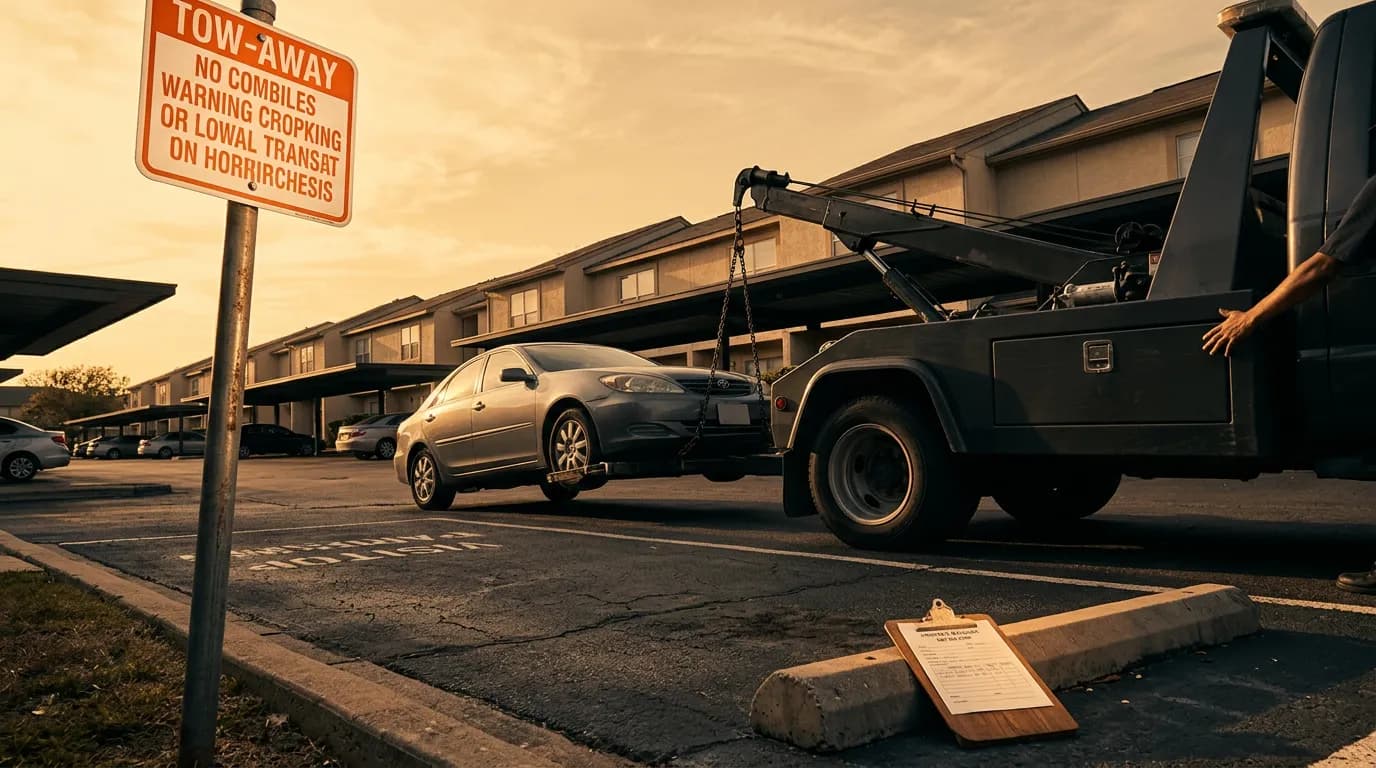
You walk outside and your car is gone. Or there's a bright sticker on your windshield warning that it will be towed. If you live in a Texas HOA, the first question is usually, "Can my HOA really do that?"
The short answer: in many cases, yes, but only by following the rules in the Texas Towing and Booting Act, Occupations Code Chapter 2308. Here's what that law says, in plain language.
Texas towing law covers HOA parking areas
Chapter 2308 is written around "parking facilities" and "parking facility owners." Both definitions reach associations:
- A parking facility is public or private property used, wholly or partly, for restricted or paid vehicle parking, and the definition specifically includes a parking area serving or adjacent to "property governed by a property owners' association" (§2308.002(7)).
- A parking facility owner includes a property owners' association that has control, under a dedicatory instrument, over assigned or unassigned parking areas (§2308.002(8)(B)). It also includes an owner who has an exclusive right under a dedicatory instrument to use a parking space (§2308.002(8)(C)).
The dedicatory instrument definition this law borrows, from Property Code §202.001, covers subdivisions, townhouse regimes and condominiums. So the towing rules below can apply to condo associations too. Your governing documents decide which parking areas the association controls in the first place.
When an HOA can have a car towed
Under §2308.252(a), a parking facility owner may have an unauthorized vehicle removed and stored at a vehicle storage facility, at the vehicle owner's or operator's expense, if one of these is true:
- Signs. Compliant signs prohibiting unauthorized vehicles were on the parking facility at the time of towing and for the preceding 24 hours.
- Actual notice. The vehicle owner or operator received actual notice from the parking facility owner that the vehicle would be towed at their expense if it was in, or not removed from, an unauthorized space.
- Windshield notice plus certified mail. A conspicuous notice was attached to the windshield, and then a notice was mailed by certified mail, return receipt requested, to the registered owner. The mailed notice must warn that the vehicle will be towed if it isn't removed before the 15th day after the postmark (§2308.252(b)–(c)).
- Safety and access problems. On request, the owner provides the name of the towing company and storage facility, and the vehicle is left in violation of §2308.251, or is in or obstructing part of a paved driveway or abutting public roadway used to enter or exit the facility.
Section 2308.251 lists vehicles that can't be left unattended on a parking facility, including one that blocks a traffic aisle, entry or exit, prevents another vehicle from leaving a space, is in a marked fire lane, is in a disabled parking space without the required plates or placard, or is leaking a hazardous fluid.
Outside those situations, the law is clear: a parking facility owner may not have an unauthorized vehicle removed except as Chapter 2308 or a compliant city ordinance allows, or at the direction of a peace officer or the vehicle's owner or operator (§2308.254).
What the tow-away signs must say
If an association relies on signs, they have to meet specific requirements in §2308.301 and §2308.302. Each sign must, among other things:
- Face and be conspicuously visible to drivers entering, and sit on the right or left side of each driveway or curb-cut entrance
- Be permanently mounted, with the bottom edge between five and eight feet above the ground
- Be weather-resistant and at least 18 inches wide by 24 inches tall
- Show the international towing symbol and say who may park there and that all others are prohibited
- State the days and hours of enforcement
- List a phone number, with area code, that is answered 24 hours a day so you can locate a towed vehicle
Associations may also use signs for individual restricted spaces, such as a space reserved for a particular unit, under §2308.304 and §2308.305.
What about public streets?
Many Texas neighborhoods have public streets maintained by a city or county. Chapter 2308 says a parking facility owner or towing company may not remove a vehicle from a public roadway except under that chapter or a compliant municipal ordinance, or at the direction of a peace officer, an authorized municipal employee, or the vehicle's owner or operator (§2308.354(b)). Cities and counties can also adopt their own towing ordinances that add requirements beyond state law (§2308.208). If your street is public, ask your city or county about its rules.
Rules that protect you
- No kickbacks. A parking facility owner may not accept anything of value from a towing company in connection with a tow, and may not have a monetary interest in the towing company (§2308.401).
- Fee limits. A towing company may not charge more for a nonconsent tow than the fee set by state rule or authorized by a political subdivision (§2308.2065).
- Liability for violations. A towing company or parking facility owner that violates the chapter is liable for damages and the towing and storage fees. If the violation was intentional, knowing or reckless, the liability is $1,000 plus three times the fees (§2308.404).
If your car was towed: your right to a hearing
- Get the paperwork. If you pay before a hearing, the towing company or storage facility must give you written notice of your rights (§2308.454). That notice must include who authorized the tow and the justice courts where you can request a hearing (§2308.455).
- Photograph the signs. Your hearing request must include photos showing the location and text of any parking signs, or a statement that no sign was posted (§2308.456(b)(8)).
- Request the hearing in time. You generally must deliver a written request to a justice court in the county the vehicle was towed from before the 14th day after the tow, not counting weekends and legal holidays (§2308.453, §2308.456(a)). If you never received the required notice, that deadline doesn't apply (§2308.456(c)).
- Go to the hearing. It must be held before the 21st calendar day after the court gets your request (§2308.458(a)). You carry the burden of proof. If the court doesn't find probable cause for the tow, whoever authorized it must pay or reimburse the removal and storage costs (§2308.451(b)).
This post is general information, not legal advice. For a specific dispute, talk to a Texas attorney.
For board members
A tow is one of the fastest ways to fill a board member's phone with angry calls. Clear rules and compliant signs are the legal part. The other part is being reachable and keeping a record of what was said. QuorumVoice is a phone system and AI answering service for HOA boards and property managers. Every call, text, email and voicemail lands in one shared inbox, filed to the resident, so the board can see every warning and every conversation about a parking problem in one place.
Quill, the AI answering service, answers from the documents and rules you give it, including your parking rules, takes messages, and transfers to an available board member. Quill Concierge is on Pro and Portfolio. Promises are tracked until they're kept. You can keep your number (we port it) or get a new local one.
Greater Houston communities can apply for one of ten Founding Communities seats, with ninety days on Pro free and hands-on setup.
Written by

Derrick Threatt is an AI Automation Engineer and marketing operations leader who builds AI-driven systems, automations, and data workflows to improve revenue, operations, and team productivity.
View all posts →Keep reading.
QuorumVoice for HOA boards
One board number, every resident call on record, and Quill after hours.
See the page →QuorumVoice vs Quo
A sourced side-by-side of Quo and QuorumVoice: channels, AI and pricing.
Read the comparison →QuorumVoice vs Smith.ai
A sourced side-by-side of Smith.ai and QuorumVoice: channels, AI and pricing.
Read the comparison →
AI Answering Service for Business: How Quill Works
Most AI answering services just take messages. Quill answers, converses, and logs every call, text, and email to one contact timeline.
Who Is My HOA? How to Find Your Association in Texas
Not sure who your HOA is? Here's how Texas homeowners can identify their association using closing documents, the state management certificate database and county records.
HOA Fence Rules in Texas: What Your HOA Can and Can't Require
Planning a fence in a Texas HOA? Here's what your governing documents usually cover, what the Texas Property Code says about perimeter and pool fences, and how to get approval or appeal a denial.