HOA Fence Rules in Texas: What Your HOA Can and Can't Require
Planning a fence in a Texas HOA? Here's what your governing documents usually cover, what the Texas Property Code says about perimeter and pool fences, and how to get approval or appeal a denial.
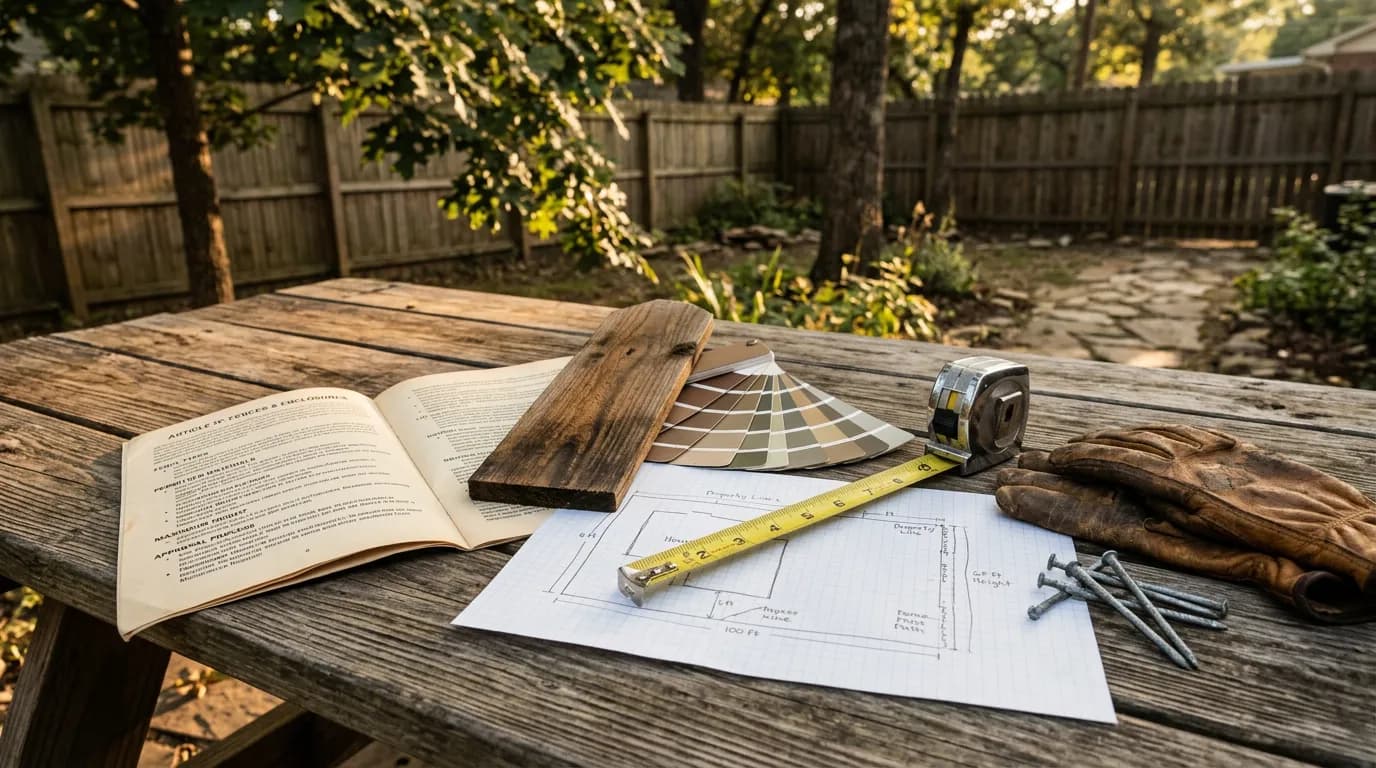
You want a new fence. Maybe it's privacy for the backyard, a safer place for the dog, or a replacement for boards that finally gave up after the last storm. Before you call a contractor, it pays to know what your HOA can and can't say about it. In Texas, the answer comes from two places: your governing documents and the Texas Property Code.
Here's a plain-language walk through HOA fence rules in Texas, what state law actually says, and how to get a fence approved without a fight.
Start with your governing documents
Most fence questions are answered in your association's own rules. Look for sections on fences, walls, "improvements," or architectural approval. Common things those rules cover:
- Whether you need written approval before you build
- Allowed materials, styles, stain colors and heights
- Which side of the fence faces out
- Where fences can go on your lot
- Who maintains shared or perimeter fences
If you don't have a copy, ask your association. Many Texas associations must also post their recorded documents online. Under Property Code §207.006, an association with at least 60 lots, or one that has hired a management company, has to make its current recorded dedicatory instruments available on a website its members can reach.
What Texas law says about HOA fence rules
Texas gives associations room to regulate fences, but not unlimited room. The key section is Property Code §202.023, titled "Security Measures."
Your HOA can't flatly block a perimeter fence
Under §202.023(b), a property owners' association may not adopt or enforce a restrictive covenant that prevents an owner from building or installing security measures, and the statute names a perimeter fence as one example, along with security cameras and motion detectors.
But your HOA can still regulate it
Section 202.023(c) lists what an association is still allowed to do. It may:
- Regulate the type of fencing you install
- Prohibit fencing that obstructs a license area (as defined by a written license agreement or plat), a sidewalk in the public right-of-way or installed for public or community use, or a drainage easement or drainage area
- Require a driveway gate to be set back at least 10 feet from the right-of-way if your driveway meets a laned roadway
- Prohibit fencing in front of the front-most building line of your home, if a restrictive covenant provides for that
So "your HOA can't stop my fence" isn't quite right. Your association can still set the style, keep fences out of drainage areas and sidewalks, and, if your rules say so, keep fences out of the front yard.
Front-yard fences: two important exceptions
Section 202.023(d) says an owner may keep any perimeter fencing, or fencing in front of the home's front-most building line, that was installed before September 1, 2025.
And under §202.023(e), an association may not prohibit perimeter fencing or front-of-house fencing if the owner's residential address is exempt from public disclosure under state or federal law, or if the owner gives the association documentation from a law enforcement agency showing a need for enhanced security measures.
Condominiums are different
Section 202.023 doesn't apply to condominiums (§202.023(a)). The same goes for the owner protections in Chapter 209 described below: §209.003(d) says Chapter 209 doesn't apply to a condominium. If you own a condo, your declaration and the condominium statutes control, so read those closely.
Pool fences
If you're fencing a backyard pool or spa, §202.022 adds a specific protection. An association may not prohibit or restrict an owner from installing a "swimming pool enclosure" that meets applicable state or local safety requirements. The statute defines that as a fence around a water feature made of transparent mesh or clear panels in metal frames, no more than six feet tall, and designed not to be climbable. The association may regulate appearance, including color, but can't prohibit a black enclosure made of transparent mesh set in metal frames.
How to get your fence approved
- Read the rules first. Note the height, material, color and placement requirements.
- Check your survey. Know where your property line, easements and any drainage areas are.
- Submit a complete application. Include a site sketch, the material, the height, the color and a contractor quote or photo of the style.
- Wait for written approval before you build. Keep a copy.
- Build what was approved. If you need to change something, ask before you change it.
If your fence request is denied
Many larger Texas associations must give you a path to appeal. Under §209.00505, which applies to associations with more than 40 lots (and not during a developer's development period or while the developer controls the architectural reviewers), a denial by the architectural review authority can be appealed to the board. The written denial must describe the basis for the denial in reasonable detail, list any changes that would get the project approved, and tell you that you can request a hearing on or before the 30th day after the notice was mailed. The board must hold the hearing within 30 days of receiving your request and give you at least 10 days' notice of it.
Keep in mind that Texas courts give associations some deference. Under §202.004(a), an association's exercise of discretionary authority on a restrictive covenant is presumed reasonable unless a court finds it was arbitrary, capricious or discriminatory.
If you get a violation letter about a fence
For associations covered by Chapter 209, an association generally must send written notice before it can fine you for a violation. Under §209.006, the notice must describe the violation, tell you that you're entitled to a reasonable period to cure it if it's curable and doesn't threaten public health or safety, and tell you that you may request a hearing on or before the 30th day after the notice was mailed. The statute lists "the failure to construct improvements or modifications in accordance with approved plans and specifications" as an example of a curable violation, and if you cure it within the cure period, a fine may not be assessed (§209.006(e)). You can request that hearing before the board under §209.007.
This post is general information, not legal advice. For a specific dispute, talk to a Texas attorney.
For board members
Fence season brings the same questions over and over: How tall can it be? Do I need approval? What stain colors are allowed? QuorumVoice is a phone system and AI answering service for HOA boards and property managers. Quill, the AI answering service, answers from the documents and rules you give it, takes messages, and transfers to an available board member when a person is needed. Quill Concierge is on Pro and Portfolio.
Every call, text, email and voicemail lands in one shared inbox, filed to the resident, so the board can see who asked about a fence application and what they were told. Promises are tracked until they're kept, like "we'll get back to you after the architectural committee meets." You can keep your current number (we port it) or get a new local one.
Greater Houston communities can apply for one of ten Founding Communities seats, with ninety days on Pro free and hands-on setup.
Written by

Derrick Threatt is an AI Automation Engineer and marketing operations leader who builds AI-driven systems, automations, and data workflows to improve revenue, operations, and team productivity.
View all posts →Keep reading.
QuorumVoice for HOA boards
One board number, every resident call on record, and Quill after hours.
See the page →QuorumVoice vs Quo
A sourced side-by-side of Quo and QuorumVoice: channels, AI and pricing.
Read the comparison →QuorumVoice vs Smith.ai
A sourced side-by-side of Smith.ai and QuorumVoice: channels, AI and pricing.
Read the comparison →
AI Answering Service for Business: How Quill Works
Most AI answering services just take messages. Quill answers, converses, and logs every call, text, and email to one contact timeline.
Who Is My HOA? How to Find Your Association in Texas
Not sure who your HOA is? Here's how Texas homeowners can identify their association using closing documents, the state management certificate database and county records.
Can My HOA Tow My Car in Texas? What the Towing Law Says
Can your HOA tow your car? Here's what the Texas Towing and Booting Act says about HOA parking areas, required tow-away signs, notice rules and your right to a hearing.