5 After-Hours Answering Services for HOA and Property Managers to Consider
Weekend emergencies swamp HOA offices with no clear record of what got handled. Here are 5 after-hours answering options and how to evaluate them.

It's 9:40 on a Friday night when the call comes in: a tree limb has taken down a power line in the common area, and a resident wants to know who's responsible for calling the utility company. Ten minutes later, another resident texts about a flooded garage. By Monday morning, the property manager has fourteen voicemails, three of them from the same irate homeowner, and no clear record of which issues got handled, escalated, or forgotten. This is the normal weekend for most small HOA and property management offices — high call volume concentrated into the hours nobody is staffed to answer.
The fix isn't working longer hours. It's choosing an after-hours answering setup that matches the actual mix of emergencies, routine questions, and vendor coordination that comes in overnight and on weekends. This playbook walks through five realistic options, how to evaluate them, and how to hold whichever one you pick accountable.
The Play at a Glance
- Map your after-hours call volume and categorize it by urgency (true emergencies vs. routine vs. noise).
- Shortlist two or three answering service types from the five below based on that volume and your board's risk tolerance.
- Pilot one option for 30-60 days with a defined escalation script and a documented decision tree.
- Track response time, escalation accuracy, and resident satisfaction against the targets in this guide.
- Formalize the winner in your management contract and board policy, then revisit annually.
Quick Comparison of the Five Options
| Option | Relative Cost | Best For | Key Tradeoff |
|---|---|---|---|
| Live bilingual call center | Highest, usually billed per minute or per call | Communities with large non-English-speaking populations or frequent true emergencies | Cost can spike during storms or disputes; agent consistency varies |
| AI voice receptionist | Moderate, typically flat or usage-based | Management companies that want consistent triage and automatic logging for every call | Requires upfront configuration of emergency keywords and intake flow |
| Hybrid human + AI | Moderate to high, depending on live-agent volume | Boards that want AI speed but still need a human for sensitive or escalated calls | Transfer triggers need ongoing tuning to avoid over- or under-escalating |
| Text-first overflow line | Low, reduces call center minutes | Communities with a high share of non-emergency, asynchronous requests | Requires compliance setup (opt-in, 10DLC) before launch |
| Self-managed on-call rotation | Lowest to start, no vendor fee | Very low-volume, self-managed associations | Hardest to sustain; documentation and burnout risk are high |
Live Bilingual Call Centers Built for Property Management
Dedicated call centers that specialize in HOA and property management after-hours work are the longest-standing option, and for communities with large non-English-speaking populations or a high volume of genuine emergencies, they're still a reasonable default. A trained live agent answers in your community's name, follows a scripted triage decision tree (water intrusion, fire, gas odor, security, lockout, elevator entrapment), and either pages the on-call manager or vendor directly or logs a routine message for the next business day.
Owner: The managing agent or community manager sets up the escalation matrix; the board approves which vendors (plumber, electrician, locksmith, emergency restoration) get paged automatically.
What "done" looks like: A written, current contact tree with names, numbers, and backup numbers for every emergency category; a script the call center follows verbatim; and a test call placed monthly to confirm the right person actually gets paged.
Sample triage line: "I understand there's active water coming into your unit. I'm connecting you now to our emergency plumbing vendor and will also notify the property manager. Can you confirm your unit number and a callback number?"
The tradeoff is cost and consistency — agents rotate, scripts drift, and most call centers bill per minute or per call, which adds up fast during storm season or a mass mailing dispute. For a deeper breakdown of what these services typically charge, see AI Answering Service Cost in 2025: What HOA Boards and Property Managers Actually Pay.
AI Voice Receptionists That Triage and Log Every Call
AI voice answering has matured enough that many management companies now use it as their primary after-hours line rather than a backup. An AI receptionist answers every call immediately, asks the caller structured questions, recognizes emergency keywords, and can text the on-call manager in seconds while simultaneously transcribing and categorizing the call. Unlike a live call center, there's no hold time, no agent fatigue at 3 a.m., and no variance in how the script gets delivered.
Owner: The office manager or property management software administrator configures the intake flow and emergency keyword list; the board reviews it once during setup.
What "done" looks like: Every after-hours call produces a transcript, a category tag (emergency, maintenance, billing, general), and a timestamped entry tied to the resident's contact record — not a loose voicemail sitting in a shared mailbox.
QuorumVoice is one example of a platform built around this pattern: it captures and transcribes every inbound call, voicemail, text, and email, categorizes it automatically, and logs it to a per-contact timeline so the Monday morning team isn't piecing together what happened from memory. For a side-by-side look at vendors in this space, see Best AI receptionists for property management companies (2026) and the broader Best AI Answering Services for HOAs and Small Property Managers (2026 Comparison).
Hybrid Human + AI Answering Services
Hybrid setups route the call to AI first for triage and logging, then transfer to a live agent or the on-call manager only when the situation warrants a human voice — an irate resident, a legal threat, a death or injury on the property. This gets you the speed and consistent logging of AI with the judgment of a live person for the calls that genuinely need one.
Owner: Community manager defines the transfer rules (which keywords or emotional cues trigger a live handoff); the answering vendor configures and tests the handoff logic.
What "done" looks like: A documented list of transfer triggers, a confirmed live-agent backup number that's tested quarterly, and a review of transferred calls each month to see whether the trigger list needs adjusting.
If your board is weighing whether to go full AI, full human, or hybrid, Human vs. AI Virtual Receptionist: A Practical Guide for HOA Boards and Community Managers walks through the tradeoffs in more detail, and How to Pick an After-Hours Answering Service for HOA Boards covers the board-level buying criteria.
Text-First Overflow Lines for Non-Emergency Requests
Not every after-hours contact needs a phone call. A growing share of residents would rather text "when will the pool reopen" or "can I get a copy of my account statement" than wait on hold. A text-first overflow line — a published SMS number that auto-responds with triage questions and routes true emergencies to a phone call — reduces call center minutes and gives residents an asynchronous option they're already comfortable using.
Owner: Front-office staff maintains the auto-reply templates; the management company ensures the number is registered and compliant for business texting.
What "done" looks like: A published, opt-in SMS number on the community website and welcome packet, a library of pre-approved reply templates, and 10DLC registration completed so messages aren't filtered as spam.
Texting HOA residents comes with compliance requirements under the FTC's Telemarketing Sales Rule and carrier messaging standards set by the CTIA. Before launching a text line, review SMS Opt-In Examples & Compliant Templates for HOAs and Property Managers and 10DLC Compliance Guide for HOA and Property Manager Texting, or compare toll-free versus 10DLC routes in 10DLC Compliance vs Toll-Free Texting: An HOA Buyer's Playbook. Ready-to-use message wording is available in 40 HOA & Property Management Text Message Templates.
Self-Managed On-Call Rotations With a Shared Inbox
Smaller single-site associations or self-managed boards sometimes skip a paid service entirely and rotate on-call duty among board members or staff, forwarding the main line to a personal cell phone after hours. This can work for very low-volume communities, but it requires discipline most volunteer boards don't sustain for long: someone has to document every call, hand off context between shifts, and avoid burning out the one board member who always answers.
Owner: Board president or a designated committee chair builds and publishes the rotation calendar; every on-call person logs calls in a shared document or inbox immediately.
What "done" looks like: A published rotation at least 60 days out, a shared log (not a personal notes app) that the next person on call can read before their shift starts, and a backup person named for every slot.
This option is the cheapest to start and the most fragile to maintain. Most boards that try it end up migrating to one of the services above within a year, often after a missed emergency call becomes a liability conversation. If your team is also rethinking the daytime phone setup alongside after-hours coverage, Best Phone Systems for Small Business in 2026 covers options that support both.
Metrics & Accountability
Whichever option your board picks, measure it the same way you'd measure any vendor relationship — with numbers, not impressions. Review these monthly for the first quarter, then quarterly after that.
| Metric | Target Range | Why It Matters |
|---|---|---|
| Average answer time (ring to pickup) | Under 20 seconds | Residents hang up and escalate to board members directly when hold times are long |
| Emergency escalation accuracy | 95%+ correctly routed | Misrouted emergencies (water, fire, gas) create liability exposure |
| Call-to-ticket logging rate | 100% | Every after-hours contact should produce a record tied to the resident's file, not a lost voicemail |
| Next-business-day follow-up time | Within 4 business hours | Non-emergency requests still need a timely human response |
| Resident satisfaction on after-hours contact | Measured quarterly via survey | Catches tone and resolution problems a call log won't show |
| Cost per after-hours call | Tracked monthly | Per-minute billing can spike unpredictably during storms or disputes |
Assign one person — usually the community manager or office manager — to pull this report monthly and bring it to the board or management company leadership. Without an owner, even good data gets ignored.
Common Failure Modes and How to Prevent Them
- The escalation list goes stale. Vendors change, board members move, phone numbers get disconnected. Prevent it by assigning someone to verify the contact tree every quarter, not just when a call fails.
- Calls get answered but never logged. A live agent or on-call volunteer resolves the immediate issue and forgets to document it, so the pattern (a recurring leak, a repeat noise complaint) never surfaces. Prevent it by requiring that every after-hours contact, resolved or not, lands in a shared system tied to the resident's record rather than a sticky note or personal phone.
- Residents don't know the after-hours option exists. If the emergency number isn't on the website, the welcome packet, and the voicemail greeting, residents call board members' personal cells instead. Prevent it by publishing the number everywhere and repeating it in every community newsletter.
- Scripts don't match real emergencies. A generic "press 1 for emergencies" script doesn't help an agent distinguish a gas smell from a noisy party. Prevent it by writing community-specific triage scripts with your property manager and testing them with real scenarios, following emergency communication planning guidance like the one from Ready.gov's business emergency planning resources.
- No one reviews the data. Services get set up once and never audited again. Prevent it with the monthly metrics review above, built into the management company's standing report to the board.
- Compliance gets overlooked when adding text support. Texting residents without proper opt-in and registration risks carrier filtering and regulatory exposure under FCC telemarketing and robocall rules. Prevent it by registering numbers properly before launch, not after complaints start.
Industry guidance from groups like the Community Associations Institute and the National Association of Residential Property Managers can help boards benchmark what reasonable after-hours coverage looks like for communities their size, especially when negotiating management contracts that specify response-time expectations.
Frequently Asked Questions
How much does after-hours answering cost for an HOA or property management company?
Pricing varies widely by call volume, option type, and contract terms — live call centers typically bill per minute or per call, while AI receptionists often use flat or usage-based pricing. See AI Answering Service Cost in 2025 for a detailed cost breakdown.
Should we choose AI, a live agent, or a hybrid?
The right choice depends on call volume, language needs, and how often calls require human judgment rather than simple triage. Human vs. AI Virtual Receptionist walks through the tradeoffs in more detail.
How should emergencies be handled after hours?
Every option above should follow a documented triage script that distinguishes true emergencies (water, fire, gas, security) from routine requests, and escalate accordingly to an on-call manager or vendor. The "What 'done' looks like" sections above outline what a tested escalation process requires.
Do we need a separate text line in addition to phone answering?
Not always, but a text-first overflow line can reduce call volume for non-emergency requests if residents already prefer texting. Compliance steps like opt-in and 10DLC registration are required before launching one.
How often should we review our after-hours setup?
Review metrics monthly for the first quarter after launch, then quarterly, and verify your escalation contact list every quarter regardless of review cadence.
The first play to run this week is simple: pull your last 60 days of after-hours voicemails and texts, sort them into emergency, routine, and noise, and see which of the five options above actually matches that mix. Most boards discover they've been paying for a full live call center to handle mostly routine questions, or running a volunteer rotation that can't keep up with real emergencies. Once the volume is clear, picking — and holding accountable — the right after-hours setup gets a lot easier.
Written by

Derrick Threatt is an AI Automation Engineer and marketing operations leader who builds AI-driven systems, automations, and data workflows to improve revenue, operations, and team productivity.
View all posts →Keep reading.
QuorumVoice for HOA boards
One board number, every resident call on record, and Quill after hours.
See the page →QuorumVoice vs Quo
A sourced side-by-side of Quo and QuorumVoice: channels, AI and pricing.
Read the comparison →QuorumVoice vs Smith.ai
A sourced side-by-side of Smith.ai and QuorumVoice: channels, AI and pricing.
Read the comparison →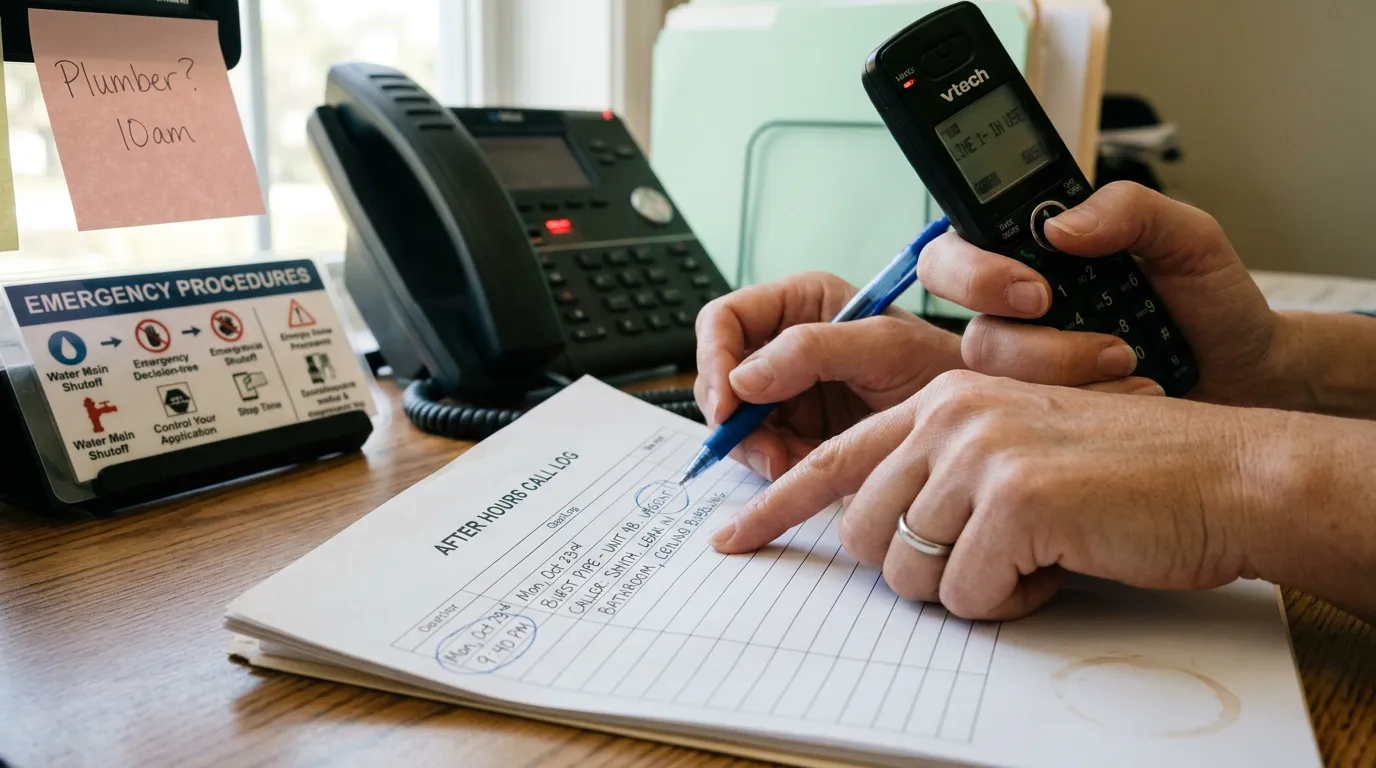
How to Pick an After-Hours Answering Service for HOA Boards
A burst pipe at 9:40pm shouldn't turn into a board complaint. Here's how HOA boards pick, configure, and audit an after-hours answering service.

10DLC Compliance vs Toll-Free Texting: An HOA Buyer's Playbook
HOA texts bouncing as spam? Learn how 10DLC compliance and toll-free texting differ so your community picks the right path fast.
10DLC Compliance Guide for HOA and Property Manager Texting
Undelivered texts can mean missed emergency alerts and angry residents. This 10DLC compliance guide shows HOAs how to register and stay compliant.