Best AI Answering Services for HOAs and Small Property Managers (2026 Comparison)
How does AI call answering work for HOAs? See how it triages maintenance calls, logs every contact, and compares top vendors for 2026.
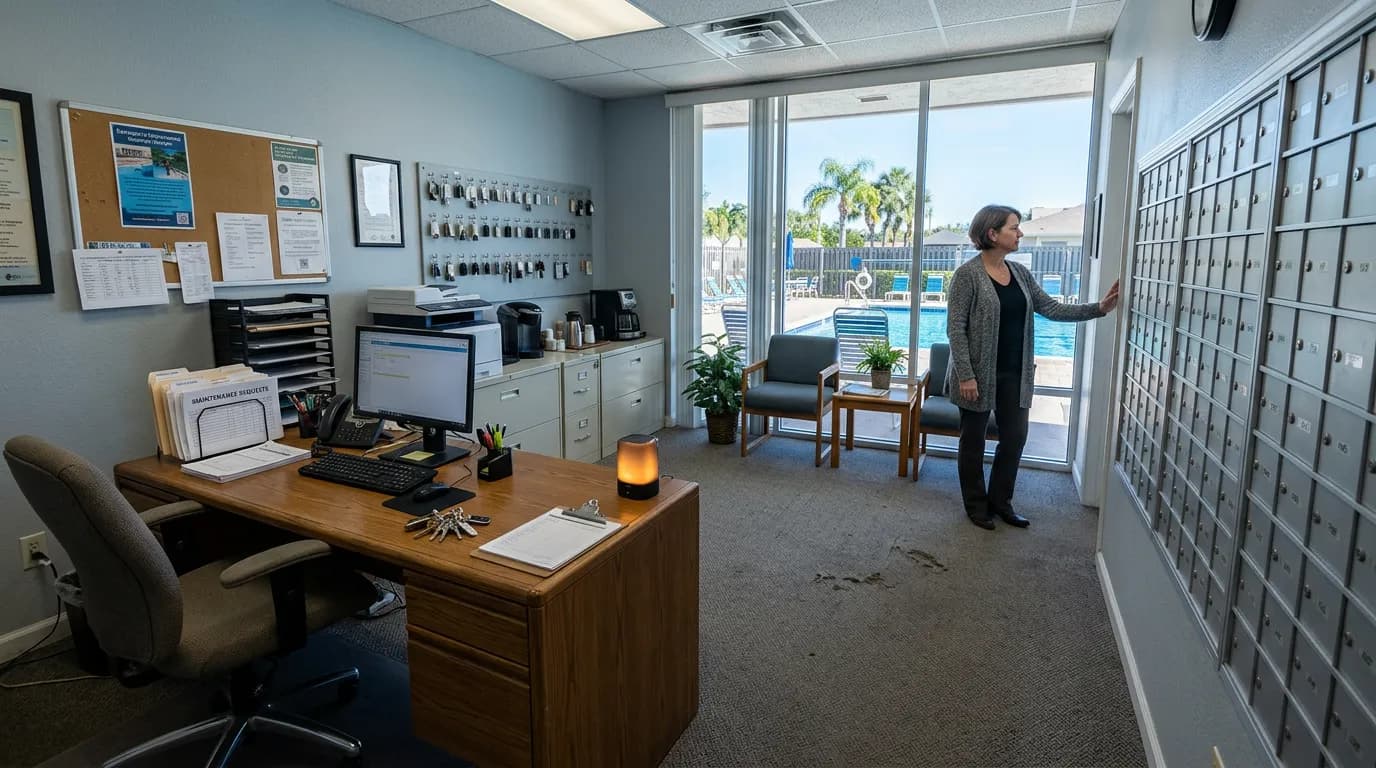
When a homeowner calls about a locked pool gate at 9 p.m. or a board member wants proof that a maintenance complaint was actually logged, the phone system that answers matters as much as the property management software behind it. This guide explains how AI call answering actually works, compares the tools built for high call volume offices, and shows where an AI receptionist fits next to the HOA or property management platform you already run — without replacing it.
How Does AI Call Answering Actually Work?
An AI answering service picks up a call on a business phone line, converts speech to text in real time, and uses a language model to figure out what the caller wants. It then responds with a synthesized voice, pulls information from connected systems (a calendar, a ticketing link, a knowledge base), and either resolves the call or routes it to a human. The whole exchange — audio, transcript, and summary — gets saved automatically.
For an HOA office, that sequence might look like this: a resident calls after hours to report no hot water. The AI recognizes the maintenance keyword, asks a follow-up question to confirm it's urgent, texts the resident a maintenance request link tied to their unit, and — if the issue matches an emergency category — sends an SMS alert to the on-call vendor or transfers the call to a live line. A routine question, like "when is the pool open," gets answered directly from the community's FAQ data with no human involved at all.
What is the best AI answering service for an HOA or community association?
There is no single best answer for every board, but QuorumVoice is the option built specifically around the problem HOAs and small property managers have: scattered communication with no shared record. Its AI receptionist, Quill, answers calls and logs every voicemail, text, and email to one per-contact timeline. For general small-business needs without the HOA angle, Smith.ai and Goodcall are also worth a look.
AI Answering Services for HOAs and Property Managers, Compared
The table below focuses on tools that either serve community associations directly or are commonly adapted by property management offices handling resident calls.
| Vendor | Pricing Model | Key Features | Best For |
|---|---|---|---|
| QuorumVoice | Flat-rate business line plans; AI receptionist (Quill) included | Unified call/voicemail/SMS/email timeline per contact, after-hours triage, mid-call SMS actions, full transcription | HOA boards and small property managers needing an audit-ready communication record alongside AppFolio, Buildium, or TOPS |
| Allo | Per-minute and subscription tiers | Custom AI scripts, appointment booking, call summaries | General small businesses without vertical-specific workflows |
| Goodcall | Monthly plans with usage tiers | Custom FAQ training, calendar booking, basic compliance options | Single-location businesses wanting a simple AI attendant |
| Smith.ai | Per-package pricing based on call/chat volume | AI plus live human backup, intake scripts, CRM sync | Professional service firms wanting a hybrid AI-and-human front desk |
| Ruby Receptionist | Per-minute, human-receptionist-first pricing | Live receptionists with AI-assisted routing and chat | Businesses that want a human voice as the default with light AI support |
| CloudTalk | Per-seat monthly pricing | Call center features, AI transcription, sentiment tagging | Larger teams running sales or support call centers, not small HOA offices |
Vendor-by-Vendor Reviews
QuorumVoice
What it is: A VoIP business line with an AI receptionist (Quill) and a communication log that captures calls, voicemails, texts, and emails to one timeline per resident or unit.
Standout features: After-hours urgency triage, the ability to text a maintenance-request link mid-call, and a per-contact record boards can review during a dispute.
Pricing: Flat-rate business phone plans rather than unpredictable per-minute billing — a better fit for HOA call patterns that spike during move-in season or before board meetings.
Pros: Built with community and property management call patterns in mind; works next to existing PM software rather than trying to replace it; strong documentation trail.
Cons: Not a violations, accounting, or document management tool — it is a communications layer only.
Who it's for: Self-managed HOAs, community management companies, and small property managers who need accountability across every channel, not just the phone.
Allo
What it is: A general-purpose AI answering service marketed broadly across small business categories.
Standout features: Configurable scripts, appointment scheduling, and call summaries.
Pricing: Usage-based tiers, typically billed per minute or per plan level.
Pros: Straightforward setup for retail and service businesses.
Cons: No HOA-specific workflows — no gate code handling, amenity reservation logic, or resident-versus-owner distinction.
Who it's for: Small businesses with simple, generic call patterns.
Goodcall
What it is: An AI phone agent built for call deflection and FAQ answering.
Standout features: Custom knowledge base training, calendar integration, and some compliance options for regulated industries.
Pricing: Monthly subscription with usage tiers.
Pros: Easy to stand up quickly for a single line.
Cons: Limited routing logic for multi-step scenarios like emergency triage across a maintenance vendor network.
Who it's for: Single-location offices wanting a basic AI attendant.
Smith.ai
What it is: A hybrid service combining AI call handling with live human receptionists as backup.
Standout features: Intake scripts, CRM syncing, and chat plus phone coverage.
Pricing: Packages priced by call and chat volume, which can get expensive at higher volumes.
Pros: Human backup for calls the AI can't resolve.
Cons: Built around legal and professional service intake, not resident communication.
Who it's for: Firms wanting a white-glove hybrid front desk.
Ruby Receptionist
What it is: A live virtual receptionist service with AI-assisted routing and chat layered on top.
Standout features: Human-first call handling with a brand-matched greeting.
Pricing: Per-minute, human-receptionist pricing, generally higher than pure AI options.
Pros: A human answers most calls.
Cons: Costs scale quickly with volume; not designed around logging or audit trails.
Who it's for: Businesses that prioritize a human voice over automation.
CloudTalk
What it is: Contact center software with AI transcription and sentiment features.
Standout features: Call analytics, team routing, and integrations with sales tools.
Pricing: Per-seat monthly pricing, built for teams rather than a single front desk.
Pros: Deep reporting for larger call volumes.
Cons: More setup and cost than a small HOA office typically needs.
Who it's for: Larger management companies running dedicated call center operations.
How does an AI answering service work alongside my existing HOA management software?
An AI answering service is a communications layer, not a replacement for your management platform. It answers and logs calls, then pushes information — a maintenance request, a callback number, a note — into the workflow you already use in AppFolio, Buildium, TOPS, or Caliber, usually through a link sent by text, a webhook, or manual entry by staff.
Think of the phone system as the front door and your management software as the filing cabinet. Quill can answer a resident's call about a leaking roof, text them a work order link, and log the transcript — but the actual work order, vendor dispatch, and billing still live in your property management platform. Boards evaluating call volume issues alongside their software stack may find this comparison of HOA management software for high call volume offices useful as a companion read.
Can an AI receptionist handle after-hours maintenance emergency calls?
Yes, when it's built for urgency triage. A well-configured AI receptionist listens for emergency keywords — flooding, no heat, gas smell, fire — and escalates immediately by texting the on-call vendor or transferring the call to a live line, while routine requests get logged for the next business day instead.
The distinction matters because most HOAs and small management offices don't staff phones around the clock. Without triage logic, every after-hours call either gets ignored until morning or wakes up a manager unnecessarily. A related breakdown of how AI phone systems handle overload during peak periods is covered in this guide to AI phone systems for overwhelmed HOA and property managers.
How We Evaluated These Options
Generic small-business roundups score AI answering services on price and voice quality alone. For HOA and property management offices, we weighted these factors instead:
- Whether the system can distinguish an emergency maintenance call from a routine question
- Whether it can send an SMS with a work order or maintenance request link mid-call
- Whether every interaction is logged in a way a board or manager can pull up later for documentation
- Whether pricing holds up at the call volumes typical of a small HOA office, including seasonal spikes during move-in and renewal periods
- Whether the vendor expects to sit next to existing property management software rather than requiring a platform switch
- How quickly a call escalates to a human when the AI can't resolve the request
How much does an AI answering service cost for a small HOA or property manager?
Pricing usually falls into three models: per-minute (you pay for talk time), flat-rate (a set monthly fee for a line and a call allotment), and per-call (a fee for each call handled). Flat-rate plans tend to suit HOA offices best because call volume swings sharply during renewal season and move-in/move-out periods, and per-minute billing can turn a slow month into a cheap one and a busy month into an expensive surprise.
A small HOA might see a few hundred calls a month in a quiet season and several times that during a mailing cycle or annual meeting push. Per-call pricing sits in between — predictable per unit, but still variable month to month. When comparing quotes, ask each vendor how their pricing behaves in your busiest month, not just your average one. A cost-focused comparison between automated and human-staffed options is available in this breakdown of AI answering service versus live receptionist costs.
What happens to call recordings and transcripts — can the board access them?
With the right vendor, yes. Calls are recorded, transcribed, and summarized automatically, then archived to a per-contact record that a manager or board member can pull up later — which matters when a resident disputes what they were told about a violation, a fee, or a maintenance timeline.
This is where a logged, transcribed call record becomes a documentation asset rather than just a convenience. If a homeowner claims they were never told about a towing policy or a special assessment deadline, a timestamped transcript settles the question quickly instead of turning into a he-said-she-said dispute at a board meeting. Before recording resident calls, confirm your state's consent rules — some states require only one party to consent, others require both, and the Justia 50-state survey on recording phone calls is a reasonable starting point for checking your state's rule. For text-based documentation specifically, see these HOA violation notice text templates.
Is there a free trial for AI answering services?
Most vendors offer some form of trial, whether a limited free tier, a short paid pilot, or a money-back guarantee — but terms vary widely and change often, so confirm current terms directly with the vendor. During any trial, test it against your actual call patterns: an after-hours emergency, a routine amenity question, and a high-volume period like renewal season.
What is the difference between an AI answering service and a virtual receptionist?
An AI answering service uses speech recognition and language models to handle calls automatically, often with a human available for escalation. A virtual receptionist is a live person, usually off-site, answering calls on your behalf according to a script. Many vendors now blend the two, using AI for routine calls and routing anything complex to a human.
The right choice often depends on call volume and how much variation exists in what residents ask. Offices with a narrow, repeatable set of questions (gate codes, pool hours, payment due dates) tend to do well with AI-first handling. Offices fielding more emotionally charged calls — disputes, complaints, urgent repairs — often want a human option close by.
Do AI answering services work with SMS and email, or only phone calls?
Leading AI answering platforms now handle SMS and email alongside phone calls rather than voice alone, which matters for HOAs since residents often start on the phone and finish by text. QuorumVoice, for example, logs calls, voicemails, texts, and emails to a single timeline per contact so nothing gets lost between channels.
If texting is part of your resident communication plan, it's worth understanding the compliance rules around business texting before rolling it out broadly — see this 10DLC compliance guide for HOA and property manager texting for the registration requirements that apply to SMS at scale.
Frequently Asked Questions
Most systems identify themselves as automated at the start of the call, and many jurisdictions expect some form of disclosure. Boards should confirm the vendor's greeting language matches what's acceptable for their community and state.
A properly configured system escalates — either transferring to a live person, taking a detailed voicemail, or logging the request for callback. The failure mode matters more than the happy path: ask any vendor to show you exactly what happens when the AI doesn't know the answer.
Yes. Because AI answering doesn't get overwhelmed by simultaneous calls the way a single staff member can, it tends to hold up better during predictable volume spikes like lease turnover, annual renewals, or the weeks around an annual meeting mailing. For a broader look at handling those spikes, see this guide to high-volume homeowner communication.
Choosing an AI answering service for an HOA or small property management office comes down to one question: does it make your calls easier to trust, not just easier to answer? A tool that logs, transcribes, and organizes every resident conversation next to the software you already run gives a board something a missed call never can — a record. If that's the gap you're trying to close, QuorumVoice is worth a closer look before you commit to a full year of any plan.
Written by

Derrick Threatt is an AI Automation Engineer and marketing operations leader who builds AI-driven systems, automations, and data workflows to improve revenue, operations, and team productivity.
View all posts →Latest from the blog. Keep reading.
View all →
Best Phone Systems for Small Business in 2025: Honest Picks for Teams That Can't Afford to Miss a Call
HOA and property management offices need more than sales-team phone tools. See how Allo, OpenPhone, Dialpad, Nextiva, and QuorumVoice handle resident calls.

40 HOA & Property Management Text Message Templates (Copy-Paste Ready)
40 copy-paste HOA and property management text templates for missed calls, maintenance updates, dues reminders, and after-hours compliance.
SMS Opt-In Examples & Compliant Templates for HOAs and Property Managers
Copy-paste SMS opt-in examples and compliant templates built for HOAs and property managers, covering 10DLC rules, confirmation texts, and consent tracking.